
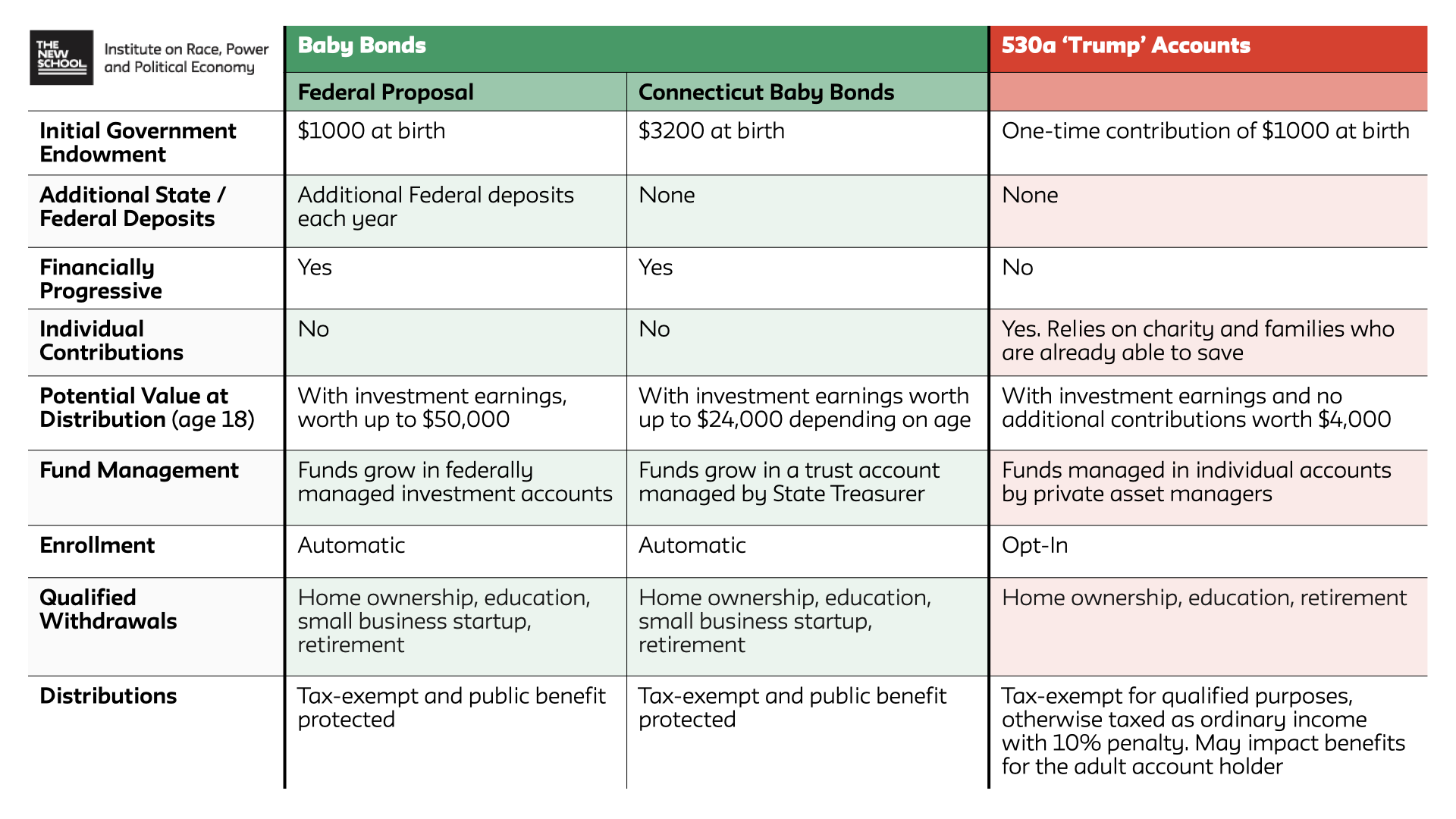
The launch of federal 530a “Trump Accounts” has elevated a core idea long championed by Baby Bonds: that wealth—not just income and hard work—matters, and that government has a role in shaping children’s asset starting points. In this sense, Trump Accounts validate a central premise of Baby Bonds while also highlighting why policy design matters. By contrasting voluntary savings with automatic, progressive endowments, they sharpen the case for Baby Bonds as a structural investment in children born with fewer resources, rather than a model reliant on charity or individual capacity to save.
At the same time, Trump Accounts in their current form carry serious risks. They are unlikely to reach children with the fewest resources and may disproportionately benefit families already positioned to accumulate wealth. Framed around opt-in participation and private top-ups, they risk reinforcing individual effort rather than unequal starting points—the opposite logic of Baby Bonds. States can welcome federal attention to childhood wealth while clearly advancing automatic, targeted Baby Bond policies that narrow the wealth gap, ensuring that new federal programs do not crowd out more equitable, state-led solutions.
This page will feature resources, research, and media that describe 530a Accounts and how they compare with Baby bonds.
IN THE NEWS

Dell CEO Pledges $6.25 Billion to “Trump Accounts for Children”
Institute Founding Director Darrick Hamilton told The Washington Post, “The reliance on the charitable contributions of philanthropy or corporate leaders leaves us vulnerable to their whims and the fickleness of their charitable inklings. That’s not to disparage the generosity of people who support these initiatives.”
The Washington Post | 12.2.2025

Trump’s Child Accounts: What Dell’s Six Billion Dollar Gift Can And Can’t Fix
“If you strip away the branding, Trump accounts look less like Baby Bonds and more like another entry in the long history of upside-down tax expenditures, where the largest dollar benefits flow to those in the highest brackets.”
Forbes |12.2.2025

Billionaires Find a Way to Give Away Money and Make Trump Happy
Institute Founding Director Darrick Hamilton said, “I don’t want to criticize well-meaning philanthropists who want to make a difference. It can be done so much better. Philanthropy can be fickle. At the end of the day, it’s government’s responsibility.”
Bloomberg | 12.3.2025

Who Will Benefit from the New “Trump Accounts” For Kids?
“[Senator Cory] Booker finds himself confronted with Trump’s twist on ‘Baby Bonds,’ which is a lot less generous toward poor people than the original proposal and is, in fact, quite likely to prove a boon for wealthy parents and their children.”
New York Magazine | 12.4.2025

“The Dell family’s investment in these new child savings accounts is meaningful—but economic justice cannot and must not depend on the benevolence of billionaires. That’s why I continue to call on Secretary Bessent to issue equitable guidance to ensure Trump Accounts uplift our most vulnerable families and not leave these children behind.”
Rep. Ayanna Pressley’s Office | 12.4.2025
“A new savings vehicle, dubbed “Trump accounts,” is designed to help the rising generation of American children build wealth into adulthood. The Institute’s Professor Darrick Hamilton compares and contrasts his Baby Bonds idea with the Trump administration's mechanism.”
Bloomberg | 12.24.2025

Billionaire-funded Trump Accounts won’t end child poverty
“The truth is that the U.S. falls behind peer countries from the developed world in its fight against child poverty. These deprivations are particularly harmful to children of color due to the deterministic role that structural racism plays in the American economy.”
Economic Policy Institute | 1.6.2026
Trump Accounts: Who Benefits From the New Child Savings Accounts?
In a new commentary, Amy K. Matsui examines the limitations of “Trump Accounts,” arguing that their design disproportionately benefits families who already have wealth while falling short of meaningfully addressing economic inequality.
The Fulcrum | 3.3.2026
The Tricks and Traps of Trump Accounts
A new analysis examines the structure of Trump Accounts, featuring Institute Director David Radcliffe; this piece raises concerns about administrative fees and privatized management that could erode long-term savings.
The New Republic | 4.7.2026
MORE NEWS
Crains Chicago Business
Trump Accounts Complicate the Wealth Gap Debate
April 13, 2026
Seven Days
Baby Bonds Versus Trump Accounts
April 15, 2026
The Washington Informer
The Truth About Trump Accounts and Black Wealth
February 2, 2026
NJ.com
Don’t get duped. Trump’s baby accounts won’t close N.J.’s racial wealth gap. | Opinion
February 1, 2026
Kindred Futures
Trump Accounts will turbocharge wealth for families who already have it, and the racial wealth divide will grow
January 20, 2026
Quartz
'Trump Accounts' for babies could make economic inequality worse
January 30, 2026
Brookings
What are Trump accounts? What are Baby Bonds?
December 30, 2025
The Connecticut Mirror
Treasurer: CT Baby Bonds Target Inequality; ‘Trump Accounts’ Don’t
August 12, 2025
Albuquerque Journal
Top NM Democrats Not on Board with Trump's 'Baby Bonds' in Federal Budget Bill
July 19, 2025
News From The States
Baby bonds economist says so-called Trump accounts ‘co-opted a good idea’
July 18, 2025
Smerconish
Will your baby qualify for $1,000 from the Trump administration?
July 5, 2025
MS Now
Will your baby qualify for $1,000 from the Trump administration?
June 26, 2025
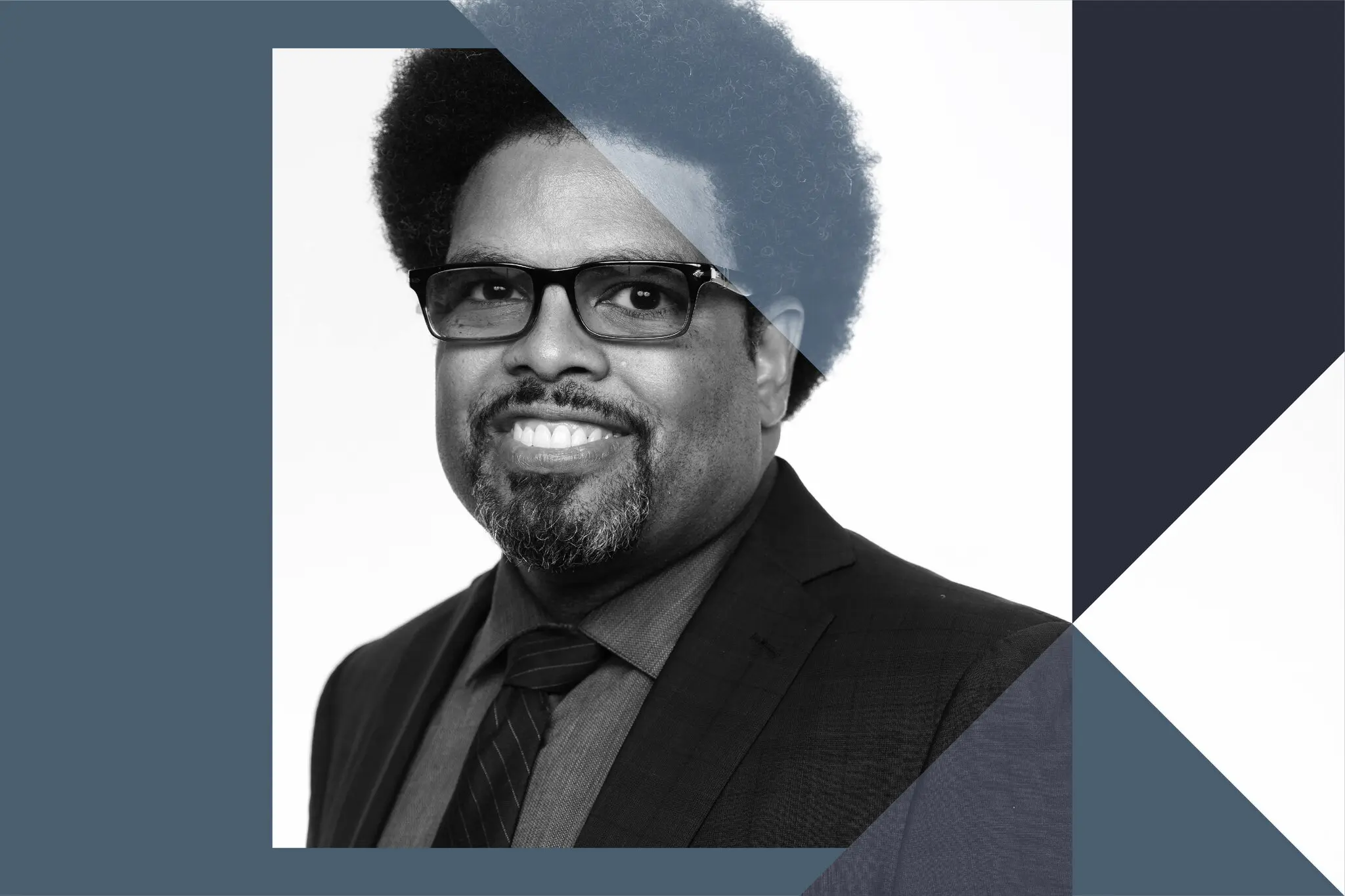
"Why This Economist Wants to Give Every Poor Child $50,000": Talking Baby Bonds with Ezra Klein
In this interview for The New York Times, Darrick Hamilton joined The Ezra Klein Show to discuss how policy shapes the structure of wealth in the U.S., and how tools like Baby Bonds can be used to foster economic and racial equity. Read more >>

A Promise Kept: Baby Bonds Triumph in Connecticut
In 2023, Connecticut became the first state in the country to pass and fully fund Baby Bonds legislation. In this op-ed for Connecticut Post, Founding Director Darrick Hamilton and Shawn T. Wooden, former treasurer for the state of Connecticut, wrote about the significance of the Connecticut Baby Bonds Trust. Read more >>