
The Superbundle™: Advancing Maternal Health Through Economic Security
Via Yale School of Medicine / Child Study Center
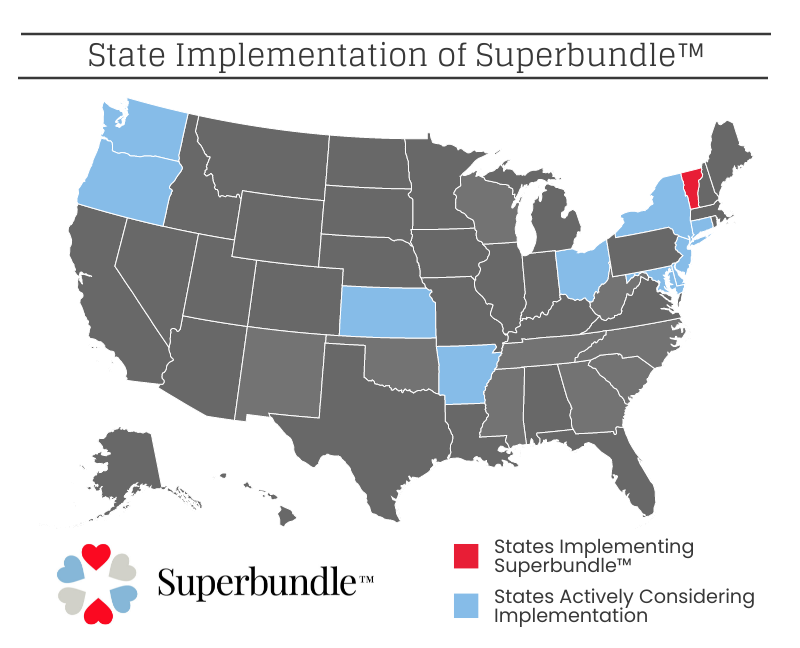 The United States is facing a maternal health crisis. Nearly 1,000 women die each year from preventable pregnancy-related causes, with Black and Indigenous mothers experiencing mortality rates nearly three times higher than white mothers. These inequities are not driven by biology alone or even by healthcare quality. They reflect the broader economic and social conditions in which mothers live.
Decades of research show that roughly 80% of health outcomes are shaped by factors outside of the healthcare system—such as access to stable housing, livable wages, basic material needs, social support, and economic opportunity. For mothers, these conditions are deeply shaped by structural racism and economic inequality that accumulate across generations and directly affect health before, during, and after pregnancy.
The Superbundle™ is an integrated policy and program solution created to respond to this reality.
What Is the Superbundle™?
The Superbundle™ is an integrated, evidence-informed approach that addresses maternal health inequities by combining immediate support with strategies to address long-term economic security. The Superbundle brings together three proven and complementary strategies targeting the largest upstream drivers of inequities in maternal health:
- Reducing Stress and Supporting Mental Health
- Meeting basic material needs, such as diapers, through partnerships with diaper banks
- Strengthening coping and mental health skills through the MOMS Partnership®, a brief, group-based, trauma-informed mental health program
- Stabilizing Income During Critical Periods
- Providing direct cash transfers to help families navigate economic shocks during pregnancy and the postpartum period
- Building Wealth for the Future
- Investing in Baby Bonds to support long-term asset building, economic mobility, and intergenerational financial security
Together, these strategies are designed to improve maternal and child health outcomes—not just in the moment, but across generations.
Why Economic Security Is Central to Maternal Health
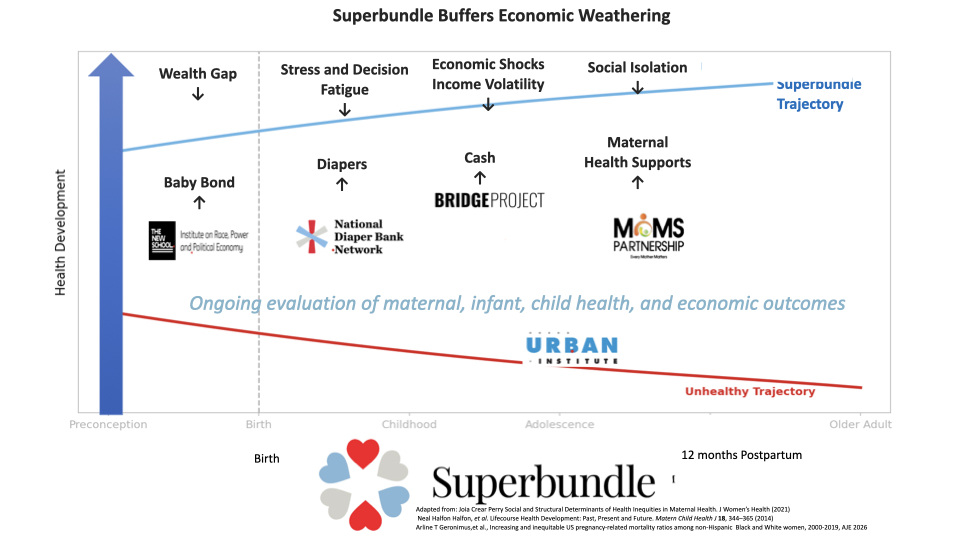 Income matters for health—but wealth matters even more. Wealth provides stability, buffers families against economic shocks, and creates opportunities to invest in the future. It reduces chronic stress and supports long-term wellbeing across generations.
Programs like Baby Bonds represent a powerful wealth-building strategy with strong implications for maternal and child health. By providing a financial asset at birth that grows over time, Baby Bonds can interrupt what researchers call “economic weathering”—the cumulative health toll of prolonged exposure to poverty, instability, and limited opportunity. These disadvantages shape health well before pregnancy begins and often persist into the next generation.
Pregnancy, infancy, and adolescence are especially sensitive periods for brain development and lifelong health. Wealth-building strategies that begin early—particularly those enrolling pregnant people and infants—can promote healthier pregnancies, stronger early development, and improved outcomes across the life course.
But long-term solutions alone are not enough.
Mothers Need Support Now
While life-course approaches are essential, they do not address the immediate financial stress many families face during pregnancy and early parenthood. When mothers are asked, they regularly describe daily anxiety about paying bills, affording food and diapers, securing housing, and covering transportation to healthcare appointments. These pressures fuel chronic stress, social isolation, and poor mental health.
When families receive flexible cash assistance, they consistently use it to meet immediate needs—diapers, transportation, utilities, and other essentials that reduce stress and stabilize daily life.
Listening to mothers means addressing both the structural drivers of maternal health, like income and wealth, and the urgent, everyday needs that shape stress, mental health, and wellbeing during pregnancy and postpartum.
First Steps Forward: Vermont’s Superbundle Pilot
A Coordinated Investment in Families
First Steps Forward is designed as more than a savings account. It is a coordinated strategy that pairs long-term asset building with immediate family support.
In addition to Baby Bonds, participating families will have access to expanded maternal mental health supports delivered in partnership with the MOMS Partnership, a nationally recognized, evidence-based program developed at Yale that focuses on supporting mothers’ mental health and economic mobility. By integrating maternal mental health into the pilot, Vermont is addressing the reality that economic stability and emotional well-being are deeply connected.
Families will also receive direct cash and diaper assistance during early childhood, supported in collaboration with The Bridge Project and the National Diaper Bank Network, respectively. Diaper need is one of the most common and immediate financial stressors facing families with infants, with nearly half of U.S. families struggling to afford diapers, according to the NBDN's 2026 Diaper Check report. Addressing it directly helps reduce hardship during a child’s most formative years.
On the ground in the Northeast Kingdom, Northeast Kingdom Community Action (NEKCA) will serve as our local implementation partner. As a trusted community-based organization, NEKCA will work directly with families to administer services and ensure the program reflects local needs and realities.
These early investments reduce stress, strengthen family stability, and improve outcomes for both parents and children. When families are supported early, children are more likely to thrive. When young adults have assets, they are more likely to plant roots. Together, these supports aim to build both economic mobility and long-term community connection.
Beginning in 2027, the program will be implemented in three counties in Vermont’s rural Northeast Kingdom. The pilot responds directly to state data showing that poverty and mental health challenges are strongly linked to maternal mortality:
- 88% of mothers who died during pregnancy or the postpartum period were enrolled in Medicaid
- 69% were participating in WIC
- Nearly 90% had a diagnosed mental health condition
The Urban Institute will evaluate the impact and effectiveness of First Steps Forward. Outcomes will include:
- Maternal and infant mental health
- Social isolation and stress
- Employment and economic stability
- Healthcare utilization
- Longer-term economic and wealth-building outcomes
Beyond generating evidence, the pilot aims to raise public awareness and inform policy solutions that better support families during pregnancy and early parenthood.
History and National Context
The Baby Bonds concept was developed by economist Dr. Darrick Hamilton as a policy response to the racial wealth gap and broader wealth inequality in the United States.
In 2023, Connecticut became the first state to implement a statewide Baby Bonds program. Similar legislation has been introduced at the federal level by Senator Cory Booker and Representative Ayanna Pressley.
Vermont’s pilot builds on this growing national momentum while tailoring the approach to the needs of rural communities and the long-term sustainability of our state’s economy.
Key Superbundle Resources and Media
Vermont Baby Bonds Media Coverage
Seven Days (April 2026) – Letter to the Editor: Baby Bonds Versus Trump Accounts
Seven Days (March 2026) – New Government Programs Help Parents Save for Kids’ Future
Institute on Race, Power and Political Economy (Jan 2026) – A Superbundle for Maternal Health and Wealth
NBC5 (Dec 2025) – Vermont Baby Bonds pilot gets $300K investment from M&T Bank
Vermont Public (July 2024) – New baby bonds pilot program aims to address Vermont's wealth gap
Additional Resources
Office of Vermont State Treasurer – Baby Bonds
Rep. Ashley Bartley – Baby Bonds: Investing in Rural Prosperity
Institute on Race, Power and Political Economy – Beyond the Bank Account: How Baby Bonds Help Create a Healthier Future
Institute on Race, Power and Political Economy webinar featuring Treasurer Pieciak – Exploring Baby Bonds: The "Superbundle" Approach to Maternal Health and Wealth
Yale School of Medicine – Pioneering Approach Aims to Improve Family Health and Wealth Across Generations
Journal of American Medical Association Network – National Support for Wealth-Building for Children From Low-Income Households