Dr. Amara Enyia on how to build a better system of global economic justice based on inclusive economic rights
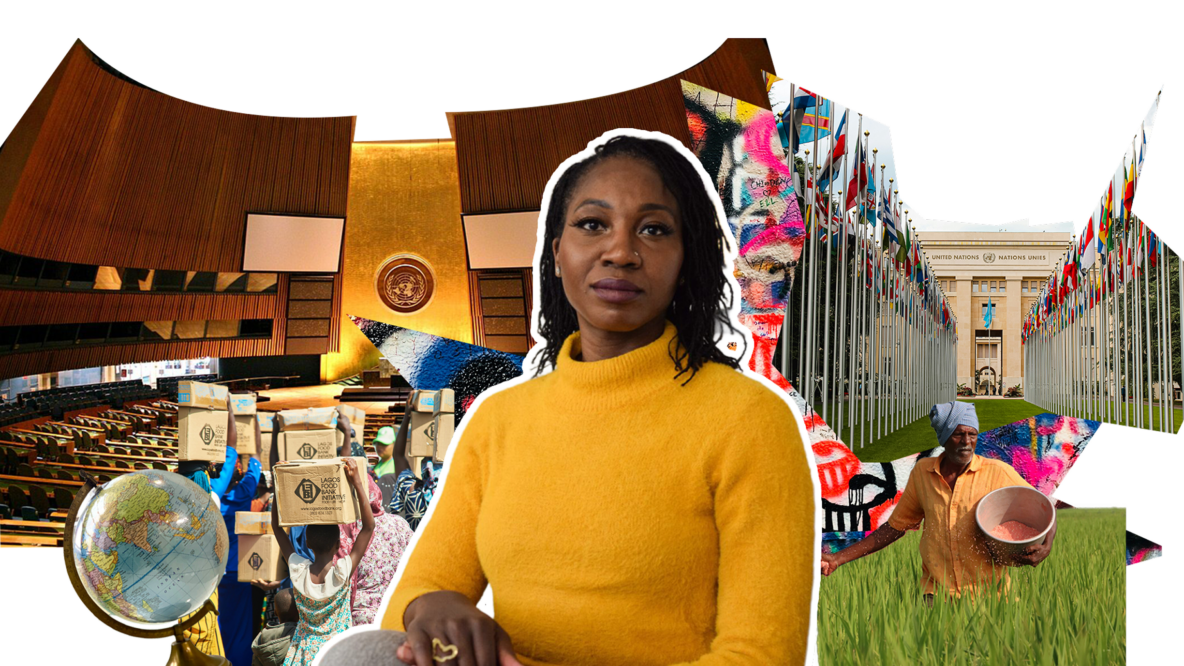
Dr. Amara Enyia began her policy career as an organizer in Chicago. She has since taken her work to the global stage — from grassroots movements to the halls of the United Nations, where she co-founded and chairs the International Working Group for the UN Permanent Forum on People of African Descent. Her work sits at the intersection of local organizing and global policy, grounded in a commitment to advancing justice across borders.
Most recently, she was invited by Ghana’s Ministry of Foreign Affairs to speak at a high-level meeting ahead of a UN General Assembly resolution recognizing the transatlantic trafficking of enslaved Africans as a crime against humanity. The meeting was led by President John Dramani Mahama in his role as African Union Champion for Justice and Reparations.
Dr. Enyia serves as a senior fellow and senior director of global initiatives at The New School’s Institute on Race, Power and Political Economy. She is focused on advancing inclusive economic rights on a global scale, and positioning The Institute as a leading voice in shaping the frameworks, partnerships, and policies needed to realize those rights.
As the U.S. withdraws from major treaties and steps back from UN-affiliated institutions, what opportunities do you see emerging — particularly for countries in the Global South?
The global order we’ve lived with for decades has produced deep and persistent imbalances, resulting in what is now being called a polycrisis. We’re seeing high levels of poverty and economic precarity, further consolidation of wealth in the hands of a few, increasing frequency and intensity of climate and environmental disaster, ongoing war and conflict, and an economic system whose roots in exploitation, violence, and domination are becoming more and more evident around the world.
The geopolitical landscape — through shifting alliances, challenges to long-standing treaties, or the reconfiguration of global institutions — is undergoing significant disruption. But while disruption can be destabilizing, it also creates openings.
In the Global South, many nations are saddled with debt burdens that severely constrain their ability to invest in the well-being of their people. Many of those states have less power than multinational corporations operating within their very borders.
In this time of disruption, the Global South has the opportunity to challenge these entrenched systems and assert leadership in shaping a new international framework based on inclusive economic rights. This framework moves away from maximizing returns for global capital and instead organizes economies around human dignity.
At the international level, this means rethinking the financial architecture that governs development — everything from sovereign debt arrangements to trade regimes and capital markets. Practically, this could mean advocating for fairer debt restructuring mechanisms, expanding regional financial institutions, and strengthening South-South cooperation to create development strategies that prioritize people and ensure access to basic needs: housing, healthcare, education, and work.
How did we get here? And where did the post-World War II system fall short?
It’s important to recognize that the current rules-based system did not emerge by accident; it historically concentrated decision-making power among wealthier nations and global financial institutions. One of its core limitations is that it did not fundamentally transform the power dynamics of colonialism and empire — it reorganized them. As a result, the institutions that were meant to stabilize the world often ended up managing inequality rather than transforming it.
While the mechanisms of influence shifted from direct colonial rule to financial dependency, the underlying hierarchies remained. Many countries in Africa, Latin America, the Caribbean, and parts of Asia entered the postcolonial period already economically constrained. They were integrated into a global architecture where development loans, debt obligations, and extractive trade models (roots of the old colonial system) continued to limit their sovereignty.
Beyond economics, the borders and political structures that emerged created lasting tensions. In many places, boundaries were drawn without regard for existing social and political realities, contributing to conflicts that persist today.
And that’s why many countries in the Global South are now calling for a deeper rethinking of the global economic architecture — one that finally centers sovereignty, and the collective right of nations to determine their own economic futures.
What would a balanced global economic relationship look like regarding economic sovereignty and natural resources?
A more equitable global system requires sovereignty and self-determination. At its core, that means moving away from extraction and dependency toward partnership and autonomy. This balance is defined by three key dimensions:
- Resource authority: Historically, nations in the Global South were structured as sites of extraction for resources like gold, oil, and timber to enrich external powers. A balanced system would grant states real authority over these resources, ensuring they contribute to national development and public investment rather than primarily enriching multinational corporations or creditor nations.
- Policy autonomy: Sovereignty means the freedom to prioritize long-term well-being over harmful external agreements. We see the need for this in agriculture, where governments are often pressured into trade arrangements that undermine local food systems. Farmers, for example, should be able to rely on seed systems that allow for local reproduction and soil health rather than being forced into dependence on proprietary seeds from global agribusiness.
- Negotiation without coercion: A balanced relationship allows countries to negotiate without having essential resources — such as vaccines, medical supplies, or development assistance — tied to political concessions or economic access. Such coercive dynamics often force nations to sacrifice long-term interests to meet urgent public health needs.
Ultimately, sovereignty and self-determination offer the possibility of resetting power dynamics. They allow countries to assert a voice in determining how their resources are used, what agreements they enter into, and how economic policy is structured to support their people.
What is the purpose of The Institute’s global portfolio, and how does it connect to its broader mission and policy agenda?
To meaningfully address economic injustice, we have to recognize that capitalism is a global system; it doesn’t stop at the borders of the U.S., Jamaica, or Nigeria. That’s why the Institute’s global work is not separate from our domestic work, but essential to it. Because the structures that shape inequality — capital flows, debt systems, and corporate power — operate globally, we must engage with those systems at the global level if we want to meaningfully address economic injustice at home.
Take immigration. Migration patterns are shaped by international sanctions, economic destabilization, and geopolitical conflict. Or consider public spending: When governments allocate trillions to militarization, that directly impacts whether they can invest in healthcare, education, or housing.
Part of our responsibility at The Institute is to show the throughline between international political economy and everyday realities — between global financial structures and the affordability crises people experience in their daily lives. These are national choices with global implications — and global forces with domestic consequences.
In this moment of profound global transition, what role can institutions like The Institute play to help shape what comes next?
We approach this work through three strategic pillars that move us beyond analysis and toward institutional change:
- Relationship building: Reshaping global systems requires aggregated power. We cultivate networks with aligned institutions, movements, and policy actors across Central and South America, Europe, and the African continent to ensure our strategies are coordinated globally.
- Applied research and policy development: We study the global financial architecture to identify exactly where it falls short, developing concrete policy interventions to address those deficiencies. The goal is research that informs real-world change.
- Institution building: If we want a new economic paradigm, we must also help construct the institutions that can sustain it. To that end, we ensure we are present in the spaces where ideas are translated into policy and where new frameworks are being developed.
Moments of structural change open space for new ideas and new institutions. This time of deep systemic instability is not simply a challenge — it is an opportunity. There is no better time to be doing this work.