
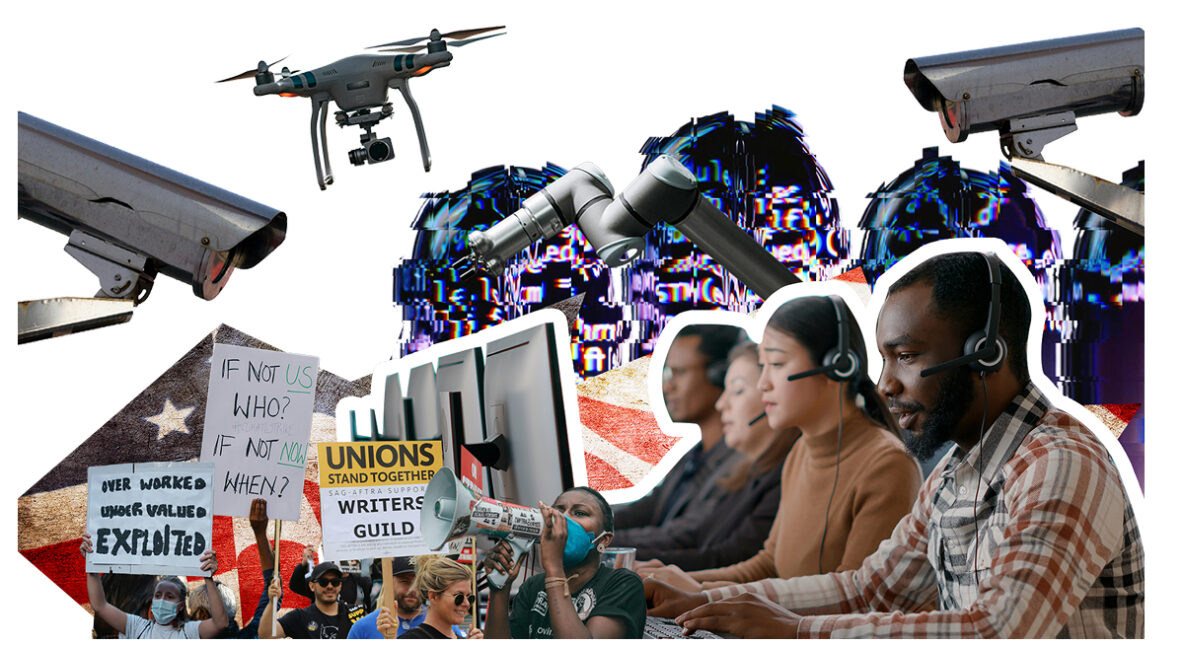
AI exploitation and surveillance are redefining work. Here’s how to reclaim human agency
Step into the home office of an agent for a particular type of call center in the United States, one of thousands connected in an AI-laced web to a digital platform. Every moment of their workday is surveilled: every call, every keystroke, every mouse movement. Their tone of voice is monitored, as is whether they’re smiling enough. The AI surveillance machine runs smoothly.
For the agents who work for a similar call center in Germany, the vibe is quite different. One AI tool zips relevant information to them when needed. Another AI tool lets them choose their shifts, optimizing a schedule based on their needs as well as those of the business. These agents’ calls are also tracked, but the data can only be used for skills training and development purposes — not for monitoring every move, mood, and smile.
The new industrial grind: powered by AI surveillance and exploitation
The difference in these scenarios, based on external reports and our own research, should serve as a dire warning about what’s happening in America.
“So much of the conversation today is about AI’s evolving capabilities — and trying to predict how AI will change work,” says Elaine Chang, Director of Technology Innovation at The New School’s Institute for Race, Power and Political Economy. “The focus is on which percent of tasks can be done by technology to then say, ‘Well, these jobs will be automated away.’”
According to Chang, that conversation misses key points. Focusing on job loss means overlooking large, diffuse changes in job quality. Companies are using a combination of technology and employment practices to make low-wage jobs even worse: lower wages, no benefits, few protections, insecure hours. “That’s not getting talked about enough,” Chang says. There’s also the idea of power. The less power a class of workers has, the more likely it is that AI will be used to erode their job quality and bargaining power. “Much of what radiologists do can be done with AI,” she says. “But because of the power of that profession, AI has tended to augment radiologists’ workflows, rather than replace them.”
It’s getting to be almost impossible to make a living from such jobs1, she adds. This shift is especially prevalent throughout the ever-growing gig economy2, retail stockrooms, and logistics warehouses. By breaking complex roles down into discrete, digitally-tracked tasks, human employees are becoming interchangeable components in a larger machine.
The solution, Chang says, lies in moving beyond regulating the technology itself and looking at structural reforms to our workplaces and economy.
High-tech AI surveillance and low-wage labor
AI is turbocharging a trend that has been shaping American business for decades. In the early 1900s, Frederick Winslow Taylor, an engineer known as the “father of scientific management,” developed a productivity strategy that promoted the dissection of work into small, simple repetitive tasks where each worker serves as a cog in the industrial wheel.
American companies have continued to enforce this narrow division of labor so they don’t have to invest in workers. By deskilling roles, companies make employees easily replaceable and reduce the need for higher wages or specialized training.
Today, this mechanized logic has been digitized: AI now serves as the ultimate supervisor, providing real-time, algorithmic instructions that turn physical labor into a series of automated cues. When a warehouse worker is guided by a screen or headset to grab items off a shelf, they are essentially acting as a low-cost robotic arm.
“With partial automation, jobs are automated until the point where it’s still cheaper to hire a really desperate human who will work for low wages and no benefits,” Chang says. This creates a paradox where even as AI manages logistics and workflow, the physical labor remains manual because cheap human hands are still more cost-effective than the complex robotics required to replace them.
This reliance on cheap, flexible labor dovetails with precarious modern employment practices like zero-hour contracts, which don’t guarantee minimum hours, and workforce fissuring, where employers remove themselves from the responsibility for their labor force by subcontracting, outsourcing, and franchising.
Unsurprisingly, Chang says, Black and Latine workers are disproportionally overrepresented in the gig and warehouse sectors because they face persistent structural racism in traditional employment, and have less access to the resources needed to climb the economic ladder3. It’s a system of exploitation, now supported by technological advancements.
The vicious cycle of algorithmic management and exploitation in the U.S.
Algorithmic management — collecting and using data to help automate hiring, firing, scheduling, and disciplining — has scaled all these trends, incentivizing a company to contract thousands, even millions, of workers for its call centers, warehouses, or delivery fleets without having to provide benefits, predictable hours, or job security.4 Depending on the job, this business model uses AI surveillance to track location, keystrokes, facial expressions, tone of voice, and more.5
While these technologies can be used positively to develop workers’ skills and enhance safety (spotting dangerous behaviors in drivers or construction workers, for example), they’re easily abused and have documented health repercussions like stress and emotional exhaustion.6 Was a customer service agent empathetic enough on a call? How many items is a warehouse worker scanning? Did a food server take too many bathroom breaks? In some cases in the U.S., how much a worker is paid and who is rehired is decided by AI.
It’s a vicious cycle. The more data AI ingests as it monitors workers, the better it can train itself to take over some of their tasks so employers can shave down wages even more. “You now have a more exploited American workforce,” says Chang, “which can’t fight back against the technology being used to algorithmically manage them.”
The EU model: Codifying worker dignity
While American workers can find themselves negotiating with an algorithm for more shifts or a corrected paycheck, Europe is establishing clear legal boundaries for AI technologies. Protections such as the EU’s 2024 Platform Work Directive7 recognize that being managed by a black box isn’t just a technical hurdle — it’s a threat to human dignity. Rather than mandating human insight for every calculator, these regulations establish a vital right to a human recourse. By ensuring that workers have access to a transparent appeals process, these rules aim to ensure that a delivery driver in Paris or a coder in Berlin is treated as an individual entitled to a human explanation for life-altering decisions (such as firings or wage cuts), rather than a data point to be optimized by a machine.
Beyond the AI surveillance algorithm: How to build a pro-worker AI infrastructure
AI is a tool. Whether it exploits — or benefits — workers depends on whether the balance of power leans more in favor of labor or management. So what can be done?
Pass laws to protect workers
In the two call center scenarios, decades of research8 by Virginia Doellgast at Cornell University shows the difference comes down to the fact that Germany has much stronger workers’ rights and protections than the United States does. “We need worker protections from invasive surveillance, algorithmic discrimination, and information asymmetries where the employer has information the worker lacks,” Chang says.
Places like California, Colorado, Illinois, and New York City have already passed legislation with targeted protections for workers around transparency, automated decision-making, and discrimination. And some new bills aim to regulate surveillance and data misuses. But we need more, Chang says. “Instead of employers owning all the data from monitoring systems, what if workers also had access to it? Uber drivers could pull back the curtain on what people call ‘surveillance wages,’ where the algorithm finds the employee willing to work for the least amount of money per ride,” she says. “The main lever in whether AI surveillance technology is used to discipline people or help them improve themselves is who gets access to that data.”
In an effort to bolster the voice of labor here in the U.S., and stop what the AFL-CIO’s Ed Wytkind calls “the weaponization of AI against workers,” the organization unveiled its first-ever agenda on AI in October 2025.9 The AFL-CIO is the largest federation of unions in the U.S., representing 15 million workers. Many of the principles it outlines for employers, legislators, and the 63 unions it represents are those practiced in Germany, including calling for tighter guardrails against the harmful use of AI surveillance and stronger collaboration between workers and employers in deploying the technology.10
After Republican-led efforts at preemption failed last year, an executive order in December grants the federal government authority to override state AI laws.11 The goal is to create a national policy. But with this administration’s deregulation ambitions, it’s unlikely to be a worker-friendly one, which is why states are ever more critical. “We’ll see how it plays out,” says Wytkind about the order’s threat to sue any state that passes new AI laws or strengthens existing ones. “There’s plenty of AI bills that are moving, and I think that they will continue.”
Build worker power
Another way to empower workers within the AI landscape is by advocating for broader, industry-wide standards. That includes sectoral bargaining — negotiating conditions across an entire industry or occupation rather than at individual workplaces. It would level the playing field for gig workers and non-unionized labor, but has struggled to gain traction in the U.S. Similarly, changes to worker classification rules expanding the definition of “employee” would ensure that a driver working 40 hours for a rideshare company gets the benefits and protections they miss out on as an independent contractor.
In Germany, unions and “works councils” comprising elected employees can negotiate policies about which AI tools will be helpful from the worker standpoint (such as giving them useful information during a call). The impact of worker bargaining power is clear in one of Doellgast’s earlier studies where she asked call center agents how much their company used performance data for discipline: 83.3% of the Germans with unions and works councils reported low use, while only 31% of Americans with unions and a mere 23.2% without unions said the same.12
Some American unions have already been successful in getting AI language in their contracts. UNITE HERE in Las Vegas, for example, now requires employers to notify its hospitality workers and negotiate with union representatives before implementing AI technologies.13 And the Transport Workers Union of America has a contract in Columbus, Ohio, that gives it veto power over the deployment of autonomous vehicles.14
Wytkind, who worked on the agenda as Interim Executive Director of the AFL-CIO’s Technology Institute, believes unions will have a strong influence in shaping how AI is implemented. Although less than 10% of U.S. workers belong to a union today15, the terms and concessions that unions fight for often end up benefitting non-unionized workers in the industry.
There’s also the idea of a jobs guarantee. “As radical as it sounds,” Chang says, “a job guarantee would raise the floor on all jobs and be one of the single largest moves to shift power to the workers.”
Expand metrics to include job quality
The current focus is on job loss and unemployment, not on the way that technology is making jobs worse. To that end, Chang says that governments should start tracking job quality, including tracking which percentage of new jobs created or lost are quality jobs that pay a living wage, with protections and benefits.
Advocate for inclusive economic rights and an inclusive economy
“We often talk about political and civil rights,” Chang says, “but political freedom without economic security is fragile.” A person who cannot afford to get sick, who cannot risk losing a paycheck, who has no cushion between stability and catastrophe doesn’t have authentic agency. Your survival, she adds, then depends on your willingness to accept whatever terms are on offer. “So what we’re talking about with programs like guaranteed income, Baby Bonds, and Medicare for All,” Chang says, “is simply a baseline level of resources so people have the ability to compete and engage.”
The Institute on Power, Race and Political Economy advocates for inclusive economic rights where people work, create, and contribute from a position of basic security. These rights can provide workers the leverage to reject low-wage jobs with exploitative AI surveillance, and also to have a say in how technology is deployed in their workplaces.
“We’re all looking for a new paradigm,” Chang says. “Once we have that, AI policies that benefit all workers will fall in place.”
- Human Rights Watch found that the median wage among gig platform workers was just US$5.12 per hour (after deducting work-related expenses and nonwage benefits of employee pay), 70% below the living wage. Human Rights Watch, The “Gig Trap”: Algorithmic Wage and Labor Exploitation in Platform Work in the US, May 12, 2025, https://www.hrw.org/report/2025/05/12/the-gig-trap/algorithmic-wage-and-labor-exploitation-in-platform-work-in-the-us. ↩︎
- Brett Christie, “Artificial Influencer: Research Suggests AI Is Widening the Pay Gap,” Workspan Daily, WorldatWork, June 20, 2024, https://worldatwork.org/publications/workspan-daily/artificial-influencer-research-suggests-ai-is-widening-the-pay-gap. ↩︎
- Ian P. McManus, “Workforce Automation Risks Across Race and Gender in the United States,” American Journal of Economics and Sociology 83, no. 2 (March 2024): 463–92, https://doi.org/10.1111/ajes.12554. ↩︎
- Brishen Rogers, “The Law and Political Economy of Workplace Technological Change,” Harvard Civil Rights-Civil Liberties Law Review 55, no. 2 (2020): 531–84, https://journals.law.harvard.edu/crcl/wp-content/uploads/sites/80/2020/10/Rogers.pdf. ↩︎
- Kathryn Zickuhr, “Workplace Surveillance Is Becoming the New Normal for U.S. Workers,” Washington Center for Equitable Growth, August 18, 2021, https://equitablegrowth.org/research-paper/workplace-surveillance-is-becoming-the-new-normal-for-u-s-workers/. ↩︎
- Sean O’Brady and Virginia Doellgast, “Collective Voice and Worker Well-being: Union Influence on Performance Monitoring and Emotional Exhaustion in Call Centers,” Industrial Relations: A Journal of Economy and Society 60, no. 3 (July 2021): 307–37, https://doi.org/10.1111/irel.12286. ↩︎
- Directive (EU) 2024/2831 of the European Parliament and of the Council of 23 October 2024 on improving working conditions in platform work, Official Journal of the European Union 2024, L series, ELI: http://data.europa.eu/eli/dir/2024/2831/oj. ↩︎
- Sean O’Brady, Virginia Doellgast, and Jelena Starcevic, “Worker Voice and Mutual Gains from Remote Performance Management: Evidence from Digitalised Services in North America and Germany,” Human Resource Management Journal 35, no. 4 (2025): 864–78.
Sean O’Brady and Virginia Doellgast, “Collective Voice and Worker Well‐being: Union Influence on Performance Monitoring and Emotional Exhaustion in Call Centers,” Industrial Relations: A Journal of Economy and Society 60, no. 3 (2021): 307–37.
Virginia Doellgast, Ines Wagner, and Sean O’Brady, “Negotiating Limits on Algorithmic Management in Digitalised Services: Cases from Germany and Norway,” Transfer: European Review of Labour and Research 29, no. 1 (2023): 105–20.
Virginia Doellgast, “Collective Voice under Decentralized Bargaining: A Comparative Study of Work Reorganization in US and German Call Centres,” British Journal of Industrial Relations 48, no. 2 (2010): 375–99.
Virginia Doellgast, “Collective Bargaining and High-Involvement Management in Comparative Perspective: Evidence from U.S. and German Call Centers,” Industrial Relations: A Journal of Economy and Society 47, no. 2 (2008): 284–319. ↩︎ - AFL-CIO, “AFL-CIO Launches ’Workers First’ Initiative on AI to Put American Workers at the Future of Artificial Intelligence,” news release, October 15, 2025, https://aflcio.org/press/releases/afl-cio-launches-workers-first-initiative-ai-put-american-workers-future-artificial. ↩︎
- AFL-CIO, Artificial Intelligence: Principles to Protect Workers, October 15, 2025, https://aflcio.org/reports/workers-first-ai. ↩︎
- White House, “Eliminating State Law Obstruction of National Artificial Intelligence Policy,” Proclamation No. 10986, December 11, 2025, https://www.whitehouse.gov/presidential-actions/2025/12/eliminating-state-law-obstruction-of-national-artificial-intelligence-policy/. ↩︎
- Virginia Doellgast, “Collective Bargaining and High-Involvement Management in Comparative Perspective: Evidence from U.S. and German Call Centers,” King’s College London, Industrial Relations (2008), 47(2), 284-319, https://ecommons.cornell.edu/server/api/core/bitstreams/740f5110-b055-4b3d-b7ab-1b61960a20cf/content. ↩︎
- Culinary Workers Union Local 226, “Culinary Union Celebrates Historic Wins for Workers in the Best Contract Ever Won with MGM Resorts, Caesars Entertainment, and Wynn Resorts,” news release, November 10, 2023, https://culinaryunion226.org/news/press/culinary-union-celebrates-historic-wins-for-workers-in-the-best-contract-ever-won-with-mgm-resorts-caesars-entertainment-and-wynn-resorts. ↩︎
- Transport Workers Union of America, “Winning Contracts That Fight Autonomous Technology,” TWU Tech Newsletter, March 5, 2024, https://www.twu.org/twu-tech-newsletter-winning-contracts-that-fight-autonomous-technology/. ↩︎
- Bureau of Labor Statistics, “Union Members — 2024,” news release, January 28, 2025, https://www.bls.gov/news.release/pdf/union2.pdf. ↩︎