

Ten statistics that expose America’s inequality — and what can be done about it

Today, the United States is arguably the wealthiest1 country in the history2 of the world, holding more than one-third of global liquid assets and producing 30% of global output.3 But its wealth distribution is so lopsided that it rivals the levels of inequality4 seen during the Gilded Age in the late 19th century, a period of extreme wealth for a select few and extreme poverty for many others. In 2024, the average CEO made 281 times5 the average worker’s pay. That means a laborer would have to start working in the 1740s and continue working until today — nearly 300 years of continuous work — to earn the pay a CEO took home in just one year.6
It’s little wonder most Americans feel like they’re barely scraping by. And it’s no accident who holds the most wealth. Over the past decade, a series of groundbreaking Color of Wealth reports led or co-authored by Dr. Darrick Hamilton, the Founding Director of The New School’s Institute for Race, Power and Political Economy, has examined the wealth landscape in seven American cities. These reports — surveying Baltimore, Boston, Chicago, Los Angeles, Miami, Tulsa, and Washington, D.C. — use fine-grained data garnered from localized surveys alongside deep research to reveal how last century’s political and economic policies continue to shape the landscape of wealth today.
The Color of Wealth reports are significant for two reasons. First, they shift the focus from income to wealth — the true measure of a household’s ability to weather emergencies and invest in its future. Unlike income, wealth is often passed down intergenerationally, meaning that disparities between groups tend to compound over time through inheritances.
Second, this localized focus allows us to trace how specific histories — including waves of migration and discriminatory local policies — directly lead to contemporary inequality. By focusing on specific cities, the reports capture hidden dimensions of wealth, such as debt burdens and asset types, to paint a much clearer picture of how systemic barriers, rather than individual choices, dictate financial outcomes. It’s a granular level of data that national surveys often miss. These data points also reveal counterintuitive findings that challenge accepted notions of wealth accumulation.
“There’s a conventional wisdom in America that if you just study hard, work hard, and put forth effort and ingenuity, you’ll have a pathway to mobility,” Dr. Hamilton says. “But no matter how you slice the data, in America, race trumps almost everything in determining an individual’s position of wealth.” That means a high level of education may not consistently translate into greater wealth across racial groups; in fact, racial wealth disparities often widen as educational attainment increases.
This finding — that a person’s life outcomes and financial security can be set by birth identity rather than their efforts or achievements — is profoundly problematic, Dr. Hamilton says: “It’s unjust, dehumanizing, and reduces people to an identity rather than their full potential and agency.”
To address this structural crisis, we first present 10 key statistics showcasing how economic power is unequally distributed in major American metropolitan areas. While some of the data points date back a decade, they provide essential context for the systemic issues still defining the American landscape today. We follow with comprehensive, people-investing remedies aimed at building equitable access to resources and capital for all Americans.
1. Median net worth

In the sprawling multicultural metropolis of Los Angeles, orders of magnitude separate the wealthiest and poorest households. The median White household is worth $355,000. The median net worth of U.S.-born Black and Mexican households is $30,000 and $5,000, respectively — roughly 8% and 1% of the White household value. Black residents who recently immigrated from Africa have a median net worth of $72,000, about 20 times higher than U.S.-born Black households but still far below White household levels. Dr. Hamilton notes that this vast disparity reflects centuries of slavery in the U.S., followed by decades of Jim Crow policies, which kept Black Americans from building assets through land, business, or homeownership.
Data source: The Color of Wealth in Los Angeles, © 2016
2. Homeownership
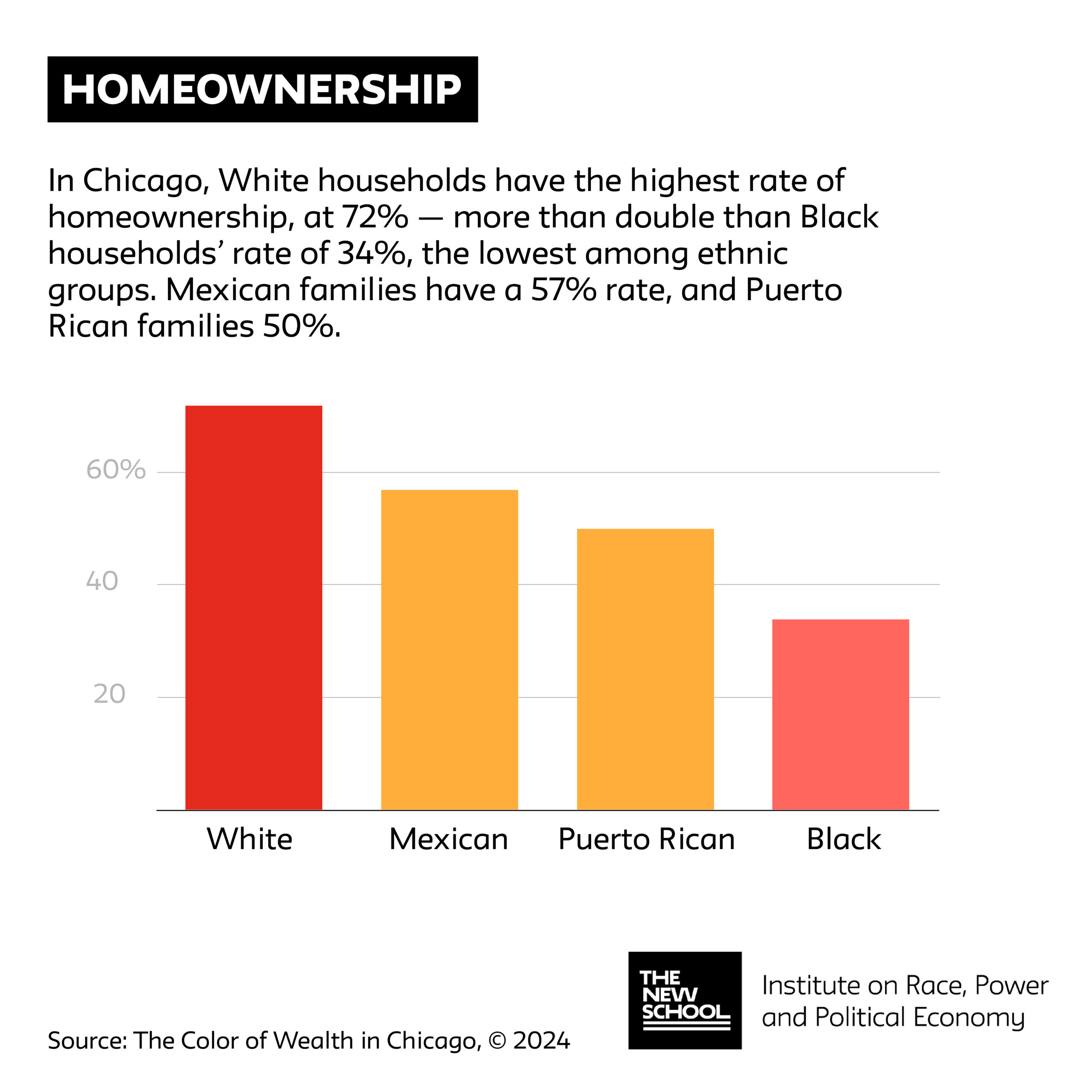
For the vast majority of Americans, a home is their most valuable asset. Personal finance courses emphasize saving for a home and homeownership as a source of civic and financial pride. But Chicago’s deep segregation7 demonstrates how this milestone has historically been reserved for White people. Until the late 1960s, Black and Latino families were legally excluded from buying in many neighborhoods through redlining, racial covenants, and racial zoning. Even when they could access a home, they were often unable to finance the purchase at the lower costs available to White buyers.
Even today, Black and Latino homeowners receive less favorable home financing8 than White purchasers, making these groups more likely to lose their home to foreclosure — as happened en masse during the 2007-2009 housing crash and Great Recession. “Black people get larger mortgages, and on worse terms,” Dr. Hamilton says, “so they are more indentured with debt burdens on this supposed pathway toward success.”
Data source: Color of Wealth in Chicago, © 2024
3. Liquid assets

Liquid assets, such as cash or a checking account, provide a cushion a person can rely on in a crisis, like a car accident or medical event. “Your liquid assets show how prepared you are to deal with all the uncertainty and vulnerability that come our way,” Dr. Hamilton says.
A lack of liquid assets permanently widens the gap between the financially secure and the financially vulnerable. A family without liquid assets is more likely to rely on expensive options in a crisis, like payday loans or a credit card. But the typically high interest rates on such products can balloon quickly, trapping borrowers in a cycle of debt that makes it more difficult to accumulate wealth.
Data source: The Color of Wealth in the Nation’s Capital, © 2016
4. Home equity

The post-WWII exclusion of Black Americans from much of the nation’s housing market coincided with the buildout of the American suburbs in the 1950s and 1960s. The scale was enormous, with 75% of all building9 taking place in the suburbs and 15 million housing units started between 1950 and 1959. The homes built there — cheaply and with government assistance — exploded in value in the decades that followed. The homes that Black Americans were able to access were on average more expensive and, in some cases, lost value over time.
Today, high-income Black families are still offered worse home-financing products10 than White families with lower resources. Black-owned homes are systematically appraised11 at lower values12 than comparable White-owned homes. This means that policies to promote homeownership are unlikely to shrink the racial wealth gap, as they can just as easily drive Black homeowners into unsustainable debt as to improve their wealth.
“When we ask people to work hard to overcome their circumstance, we don’t ask the question, ‘At what cost?’” Dr. Hamilton says. “In the case of homeownership, the cost is this huge mortgage debt, and it’s more pronounced for Black Americans.”
Data source: The Color of Wealth in the Nation’s Capital, © 2016
5. Student loans

The personal finance industry holds up higher education as a form of “good” debt,13 second only to homeownership in the return it ostensibly offers. But Black or Latino families are less likely to see that return than their White counterparts. With Black American families owning fewer assets to begin with, a college-bound Black student is more likely to need larger loans to pay for school. A Black graduate is also likely to earn less14 than a White counterpart after college, making it harder for them to climb out of debt.
“We tell Black people, ‘‘Better yourself. Go get a college degree, the natural pathway to a good life in America,’” Dr. Hamilton says. “But we indenture Black people into student loan debt at higher rates than we do White people.”
Data source: The Color of Wealth in Los Angeles, © 2016
6. Medical debt

“Medical debt is the most common reason for any American to file for bankruptcy,” Dr. Hamilton says. “Here, Black people are especially vulnerable.” Black people are more likely to be uninsured and less likely to have consistent access to preventive care, relying more on expensive solutions like emergency rooms.15
Lack of medical care ties into another factor affecting wealth accumulation: family poverty. Because people often turn to their families in times of crisis, even middle- and upper-class Black individuals are more susceptible to losing wealth when emergencies arise. Dr. Hamilton explains: “Take a middle-income Black person who is paid well,” he says. “If they have a parent, sibling, or cousin who is living in poverty, they are more likely to reach into their own assets to help.” And it’s not that Black people are necessarily more altruistic than others, he notes, but that “the networks of poverty that Black people face are a greater drain on their capacity to build wealth and pass it down to their children.”
Data source: The Color of Wealth in Baltimore, © 2021
7. Payday loans

The prevalence of high-interest, often predatory loans reflects Oklahoma’s permissive attitude toward payday lending.16 The widespread physical presence of payday loan operations on tribal land17 and on military installations reinforces this pattern.
Tulsa’s history also includes particularly violent episodes. In the 19th century, Tulsa and what was then the Oklahoma Territory received waves of Native American newcomers who were forcibly removed from their homes in the Southeastern United States. During the 1921 Tulsa Race Massacre, a White mob decimated the thriving Black community of Greenwood, killing hundreds of residents and destroying their property. The destruction of homes and businesses stripped these groups of assets and forced greater dependence on high-interest borrowing.
Data source: The Color of Wealth in Tulsa, Oklahoma, © 2021
8. Incarceration

The United States is a global outlier in the size of its incarcerated population. An estimated one in three American adults18 has an arrest or prison record, hampering their ability to find jobs and housing. The state of Oklahoma has higher rates than most as a result of its tough sentencing laws,19 which require long prison terms for what are often relatively minor offenses, and also limit early release. In addition, laws still on the books in Oklahoma20 relegate a large portion of crimes committed on reservations to federal court, regardless of severity, effectively imposing harsher sentences on Native Americans.
Prison time is a major deterrent to wealth accumulation.21 On top of resources they may have spent on their defense, people who are incarcerated (as well as their families) lose access to income they would have made on the outside — yet another layer exacerbating the racial wealth gap.
Data source: The Color of Wealth in Tulsa, Oklahoma, © 2021
9. Business assets

According to the Urban Institute, business ownership is second only to homeownership as a driver of household wealth.22 Yet Black and Latino households are less likely to own businesses because of barriers to accessing the capital that’s needed to start and sustain a business in its early years. And Black-owned businesses tend to be smaller23 than White-owned ones in terms of employees and sales, a disparity that reinforces itself over time.
This situation is particularly striking in Miami, a metropolis of Black, White, and Latin American residents that still reveals the same racial disparities as more segregated U.S. cities. When Black Miami residents are disaggregated by ancestry, those from the Caribbean have more wealth than those descended from continental American slavery. Cubans who self-identify as Black have lower employment and lower wealth outcomes than those who identify as White.
“With this data,” Dr. Hamilton says, “you can refute the narrative that cultural or individual deficits explain large, group-based disparities.”
Data source: The Color of Wealth in Miami, © 2019
10. Retirement

Most retired Americans polled in an AARP survey said they relied substantially on Social Security.24 But the program only replaces about 40% of an individual’s earnings25 — far from enough to live on comfortably. Retirement accounts with compound interest and tax breaks are a necessary addition for financially secure retirement. But they are not available to everyone because of a critical socioeconomic gap: Those with access to additional retirement accounts (like 401(k)s and IRAs) tend to have higher incomes to begin with, and to work in certain sectors that offer such benefits. Conversely, households without access to those workplace retirement savings benefits are also more likely to be spending almost all they earn, leaving them with little or no money to save for the future.
Data source: The Color of Wealth in Boston, © 2015
How to fix unequal distributions of wealth
Shrinking the racial wealth gap demands that the government actively distribute capital, according to Dr. Hamilton, rather than rely on underserved communities to finance their way into wealth through homeownership or education.
Data is crucial for that effort. “Detailed, localized data gives us the ability to uncover economic realities in a disaggregated way,” Dr. Hamilton says. “It also gives us the information needed to document, to monitor, and to fix these disparities.”
History also offers a guide as to how unequal distributions of wealth can be fixed. Eliminating debt traps is one important tactic, Dr. Hamilton says. Another is distributing capital to historically marginalized groups, because wealth grows and compounds over time. Here are other ways that could translate into specific policies:
Offer debt-free higher education
Many governments around the world already cover the cost of higher education for their citizens. A policy of free higher education in the United States would benefit hundreds of thousands of students of all races while taking a huge step to equalize the Black-White wealth gap.
“Debt-free public college rids us of the albatross of student loan debt,” Dr. Hamilton says, “and facilitates a pathway to a managerial and professional occupation” for historically marginalized communities.
“As Black people in America, we went from slavery in bondage to forms of indentured servitude such as sharecropping. There, you had the responsibility of your own upkeep, but weren’t really free. Debt became the tool of continual exploitation,” Dr. Hamilton says. “We don’t have indentured servitude anymore. But in the way we financialize exploitation via expensive student loans or expensive mortgage loans, we saddle people who are trying to overcome their circumstances with debt.”
Provide single payer health care and Medicare for All
When it comes to medical debt, universal health care through broadened Medicaid or Medicare for All could be a mechanism to get rid of the No. 1 reason that Americans go bankrupt.
Strengthen existing retirement programs, including Social Security
The solution to retirement gaps, Dr. Hamilton says, is bolstering and investing in the federal Social Security program. Strengthening this core social insurance would require a concerted political effort, as it focuses on providing guaranteed, defined benefits that create a basic floor of economic security, unlike the volatility and unequal access of private universal savings accounts. Its anti-poverty effects have been life-changing for many elderly Americans. “We’ve created these narratives that Social Security is going to go bankrupt — well, that’s a choice,” he says.
Reparations
Reparations represent a crucial retrospective policy, which authentically recognizes that current wealth inequality in America is grounded in historical deprivation, not individual choices. By acknowledging the long-term damage caused by past policies, reparations aim to directly address the lasting wealth gap. On their own, however, reparations may not provide the necessary, sustained mechanism for wealth creation across generations. “Ultimately,” Hamilton says, “reparations should be seen as part of a larger, forward-looking strategy of public policy focused on investing in people.”
Implement Baby Bonds in all 50 states
An unequal history means that, even in a perfectly fair system, Black and Latino Americans are starting behind. “All of this is inherited inequality,” Dr. Hamilton says of homeownership and home equity gaps. But the answer to wealth gaps is not better debt — it’s assets.
That’s the big idea behind Baby Bonds, an ambitious proposal to create a government-owned trust for every baby born in the United States, with larger funds for the poorest families. The scale of spending would be analogous to the GI Bill after World War II, a program that benefited eight in ten men born in the 1920s, but did so in racially discriminatory ways.
The bottom line: Invest in people and their capacity
“We reject the framing of people as mere inputs into a production process,” Hamilton says, “just as we reject the notion that addressing inequality is simply a matter of charitable redistribution.”
Investing in people is the most effective and equitable way to promote a robust economy and society. This approach fosters well-being and ingenuity, with effects that extend far beyond simple economic metrics. When entire communities are invested in, the result is greater tranquility, powerful macroeconomic multipliers, more just outcomes, and a vibrant dynamism of activity that promotes sustainable growth.
“The goal is to ensure that everyone has the resources to be self-determining and productive in the ways they define value. What better tool to facilitate this than wealth itself?” Hamilton says. “In its functional role, wealth grants choice, agency, and capabilities. When paired with stable financial capabilities and supportive structures, wealth becomes the ultimate tool for achieving true freedom and justice.”
- Thibault Spirlet, “Americans Are Richer Than Ever—at Least on Paper,” Business Insider, September 12, 2025, Business Insider, https://www.businessinsider.com/us-household-net-worth-stocks-housing-fed-data-america-trillion-2025-9. ↩︎
- Ray Dalio, “The Big Cycles over the Last 500 Years,” Principled Perspectives, May 21, 2020, https://www.linkedin.com/pulse/big-cycles-over-last-500-years-ray-dalio. ↩︎
- “The U.S. Share of the Global Economy Over Time,” Visual Capitalist, Jan. 14, 2021, https://www.visualcapitalist.com/u-s-share-of-global-economy-over-time/#:~:text=The%20Briefing,24%25. ↩︎
- “The U‑Turn That Turned America Staggeringly Unequal,” Institute for Policy Studies, November 30, 2019, https://ips-dc.org/the-u-turn-that-turned-america-staggeringly-unequal/. ↩︎
- “CEO Pay,” Economic Policy Institute, September 25, 2025, https://www.epi.org/publication/ceo-pay/. ↩︎
- “Executive Paywatch — 2025,” AFL‑CIO, https://aflcio.org/paywatch. ↩︎
- Festival of the Diaspora 2025: “Shame of Chicago Documentary Series”, YouTube, https://www.youtube.com/watch?v=MngEjcnKF-Q. ↩︎
- Raheem Hanifa, “High‑Income Black Homeowners Receive Higher Interest Rates than Low‑Income White Homeowners,” Housing Perspectives (JCHS at Harvard), February 16, 2021, https://www.jchs.harvard.edu/blog/high-income-black-homeowners-receive-higher-interest-rates-low-income-white-homeowners. ↩︎
- “Why Buying a House Today Is So Much Harder Than in 1950,” Curbed, April 10, 2018, https://archive.curbed.com/2018/4/10/17219786/buying-a-house-mortgage-government-gi-bill. ↩︎
- Raheem Hanifa, “High‑Income Black Homeowners Receive Higher Interest Rates than Low‑Income White Homeowners,” Housing Perspectives (JCHS at Harvard), February 16, 2021, https://www.jchs.harvard.edu/blog/high-income-black-homeowners-receive-higher-interest-rates-low-income-white-homeowners. ↩︎
- Dorothy A. Brown, “Homeownership in Black and White: The Role of Tax Policy in Increasing Housing Inequity,” The University of Memphis Law Review 49 (2018): 205–500, https://www.memphis.edu/law/documents/brown_final.pdf. ↩︎
- Junia Howell and Elizabeth Korver‑Glenn, “Appraised: The Persistent Evaluation of White Neighborhoods as More Valuable Than Communities of Color,” Washington, DC: National Fair Housing Alliance, November 2022, https://nationalfairhousing.org/wp-content/uploads/2022/11/2022-11-2_Howell-and-Korver-Glenn-Appraised.pdf. ↩︎
- Louis DeNicola, “Good Debt vs. Bad Debt: What’s the Difference?” Ask Experian, September 13, 2024, https://www.experian.com/blogs/ask-experian/good-debt-vs-bad-debt-whats-the-difference/. ↩︎
- Jung Hyun Choi and Laurie Goodman, “Why Do Black College Graduates Have a Lower Homeownership Rate Than White People Who Dropped Out of High School?” Urban Institute — Urban Wire, February 27, 2020, https://www.urban.org/urban-wire/why-do-black-college-graduates-have-lower-homeownership-rate-white-people-who-dropped-out-high-school. ↩︎
- Nambi Ndugga, Latoya Hill, and Samantha Artiga, “Key Data on Health and Health Care by Race and Ethnicity,” KFF, June 11, 2024, https://www.kff.org/racial-equity-and-health-policy/key-data-on-health-and-health-care-by-race-and-ethnicity/?entry=health-coverage-access-to-and-use-of-care-racial-disparities-in-health-coverage-access-and-use. ↩︎
- “Who Borrows, Where They Borrow, and Why,” The Pew Charitable Trust, July 18, 2012, https://www.pew.org/en/research-and-analysis/data-visualizations/2012/payday-lending-in-america ↩︎
- Michael B. Farley, “Caught on the Wrong Side of the Line: An Examination of the Relationship Between the Payday Loan Industry and American Indian Tribal Sovereignty,” The Journal of Corporation Law 42, no. 2 (2016–2017): 482–500, https://jcl.law.uiowa.edu/sites/jcl.law.uiowa.edu/files/2021-08/FarleyFinal_Web.pdf. ↩︎
- “Just Facts: As Many Americans Have Criminal Records as College Diplomas,” Brennan Center for Justice, accessed October 10, 2025, https://www.brennancenter.org/our-work/analysis-opinion/just-facts-many-americans-have-criminal-records-college-diplomas. ↩︎
- “Excessive Sentencing Project — Oklahoma,” National Association of Criminal Defense Lawyers (NACDL), May 14, 2013, https://www.nacdl.org/mapdata/ExcessiveSentencingProject-Oklahoma. ↩︎
- Rebecca Nagle, “Unequal Before the Law,” In These Times, March 11, 2024, https://inthesetimes.com/article/incarceration-crow-dog-deadwood-indigenous-peoples-federal-court-inequality. ↩︎
- Christian E. Weller, Akua Amaning, and Rebecca Vallas, “America’s Broken Criminal Legal System Contributes to Wealth Inequality,” Center for American Progress, December 13, 2022, https://www.americanprogress.org/article/americas-broken-criminal-legal-system-contributes-to-wealth-inequality/. ↩︎
- “How Racial Disparities in Small Business Ownership Affect Black Wealth and Economic Prosperity,” Urban Institute, June 3, 2025, https://www.urban.org/research/publication/how-racial-disparities-small-business-ownership-affect-black-wealth-and. ↩︎
- Disparities in Capital Access between Minority and Non‑Minority Businesses in the U.S., U.S. Department of Commerce, Minority Business Development Agency, January 2010, https://www.mbda.gov/sites/default/files/migrated/files-attachments/DisparitiesinCapitalAccessReport.pdf. ↩︎
- “New AARP Survey Shows Confidence in the Future of Social Security Among Younger Adults at 15‑Year Low,” AARP Press Center, July 21, 2025, https://press.aarp.org/aarp-90-social-security-survey-confidence. ↩︎
- “5 Dangers of Trying to Live on Social Security Alone,” SmartAsset, March 28, 2025, https://smartasset.com/retirement/living-on-social-security-alone. ↩︎